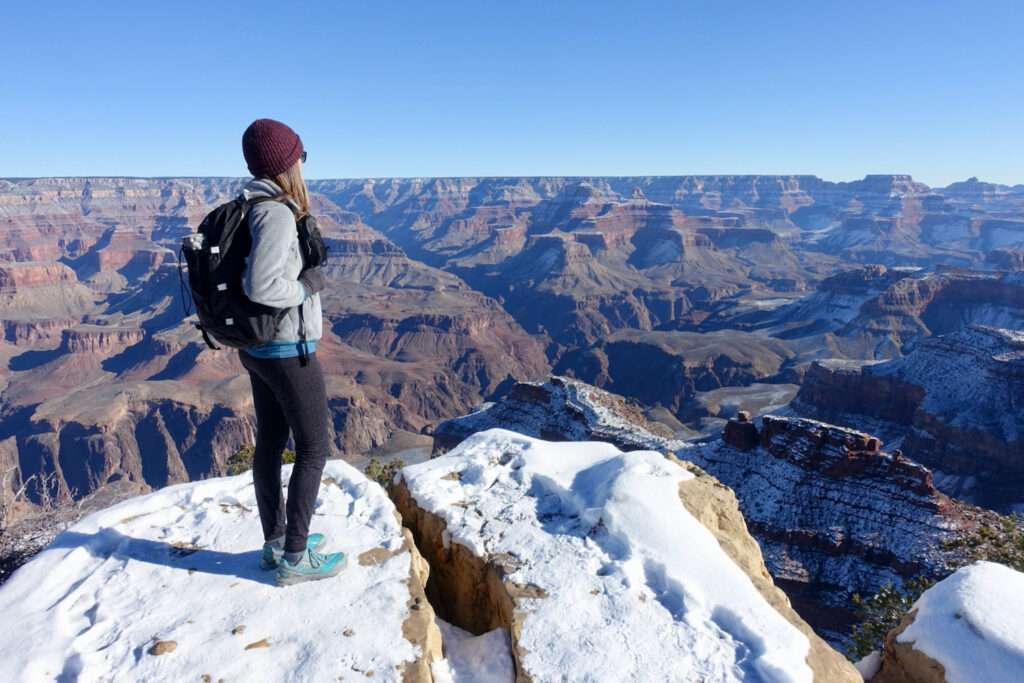
It’s no wonder the Grand Canyon is among the most visited national parks in the country. The scenery is breathtaking. But how do you choose the best day hike in the Grand Canyon when there are plenty of trails that descend deep into the canyon and some stunning rim trails with expansive vistas?
This guide highlights some of our favorite day hiking adventures in the Grand Canyon and outlines some considerations when planning your trip. Whichever route you choose, your senses will be overloaded with the immense beauty and size of this swath of canyon in the Southwest.
Best Time to Visit
For day hikers along the rim, the only limiting factor is gear, daylight, and the ability to deal with snow and ice in winter (the right clothing and footwear).
For hikers willing to dip their toes a bit further into the Canyon, it’s best to stick with backpacking season—which is generally March to June and mid-September to early November
Don’t even think about hiking into the Canyon in summer. It is an endeavor that should only be considered by seasoned hikers of canyons and deserts.
Difficulty
In the Grand Canyon, even a day hike is not without its risks and challenges. The Canyon is an extreme environment where it’s far too easy to under-estimate exertion, distance, and the amount of water you need to hike safely in the dry desert air.
That said, the main corridor trails are accessible, and those with relative fitness will feel well-rewarded hiking even a couple of miles down into the canyon.
But always keep in mind that what goes down must also come up. As a rule of thumb, it’s twice as hard to hike back up the Grand Canyon than it is to hike down into it. If you descend from the rim for an hour, it will probably take you two hours – and a lot more effort and energy – to hike back up that same stretch of trail.
One of the hardest aspects of a day hiking into the Canyon is recognizing your limits and resisting the pull of gravity and spontaneity. Legions of day hikers have been seduced into continuing on despite being short on water or gear, a reality reflected in the 250 rescues rangers record on average each year. You need to accept the fact that turning around may be your best decision many times.
What Gear Do I Need?
When heading out into the wilderness for the day, it’s critical that you have the right gear in your pack. In our article 10 Things You Should Bring On Every Day Hike, we outline what you need to have a safe and enjoyable day in the canyon.
For Grand Canyon day hikes, the three most important items on the 10 essentials list are (1) water, (2) water, and (3) water – followed by sun protection. Due to the dry desert air and extreme elevation changes, you may need to carry 3-4 liters of water for a simple day hike. You may need to leave your water bottles at home and instead wear a hydration pack or carry a 100 oz hydration bladder inside your day pack.
In addition to protecting you from UV rays, a lightweight pair of hiking pants and a sun shirt will also slow down the loss of moisture. Light layers and light colors are key.
Desert dwellers understand that air environments like the Grand Canyon require more water to stay safe. That’s even more true if you hike below the rim – where the temperatures get hotter the further down you go and your exertion levels go way up due to the steepness of the trails.
Best Day Hikes in the Grand Canyon
Day hikes at the South Rim of the Grand Canyon are fairly limited. Your best bets are the Rim Trail and the maintained corridor trails (Bright Angel, South Kaibab). Adventurous and experienced hikers could consider a few other options outlined below.
Interested in North Rim Trails?
We would normally recommend the North Kaibab Trail and the Cape Final Trail. However, the Dragon Bravo wildfire of 2025 caused extensive damage to the trails and infrastructure of the Grand Canyon’s North Rim. As of November, 2025, most North Rim hikes remain closed due to washed out trails, rockslides, treefall, and other fire damage.
The North Kaibab Trail is closed indefinitely. The fire also damaged or destroyed more than half of the buildings on the North Rim, including the historic Grand Canyon Lodge. Lodging is nearly non-existent on the North Rim, and many roads, utilities, and services remain closed.